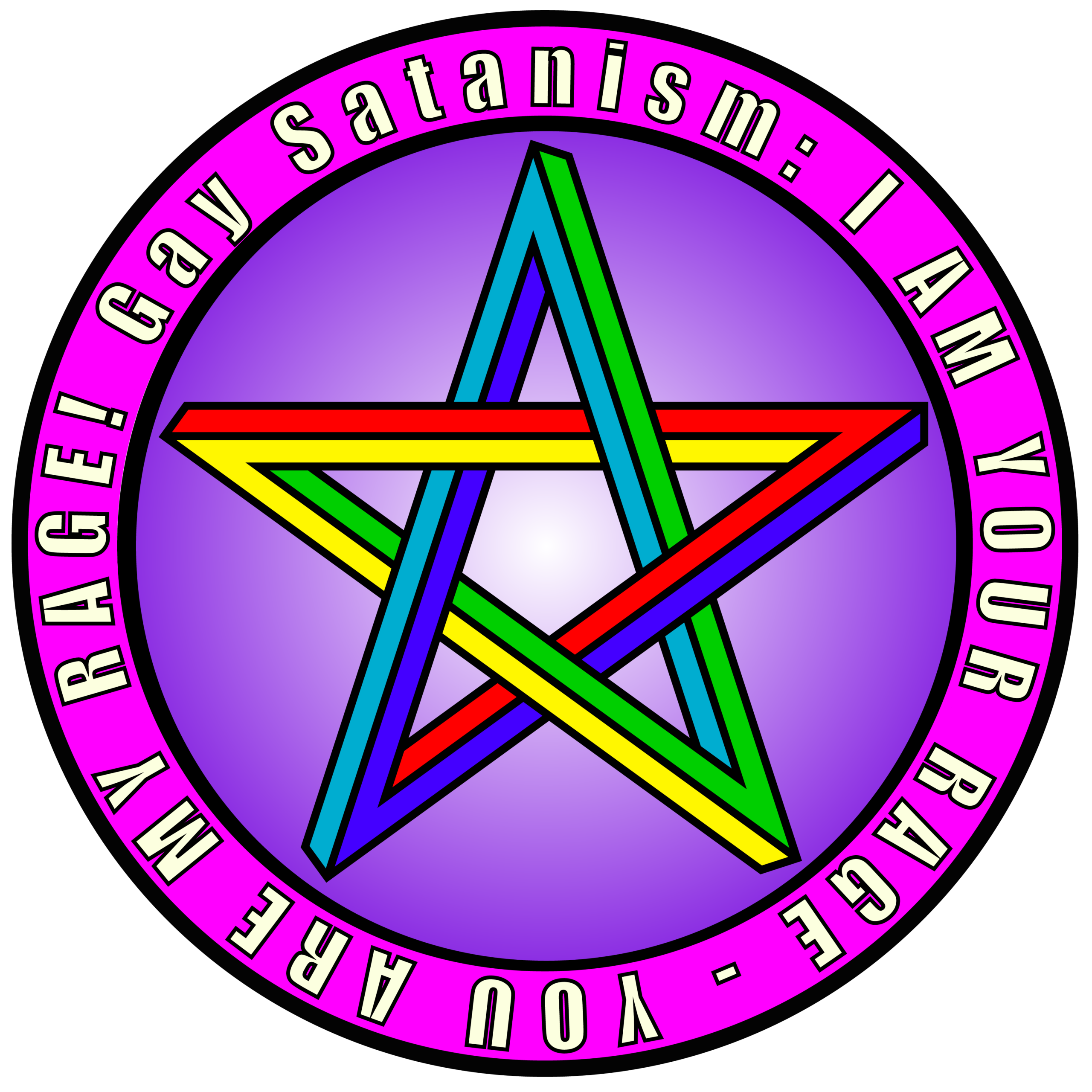

Gay Satanism belong more to Spiritual theistic satanism than to Atheistic “Gray” satanism. Gay Satanism is based on inspiration and connection of the Antichrist to EIQF. Satanists are awakened people whose awareness and critical thinking allows them to resist the insidious evil of our world and its lies. Satanists are the destroyers of evil in our world and the exposers of the oppressors of our world. Physically, informationally and magically-mentally.
Gay Satanism is also similar to the hermetic teachings of antiquity, in the sense that it intertwines various kinds of information that affects many planes of human existence in our world[1]. Considering that Satanism is a representation of the world inside the consciousness of a spiritualized person and at the same time the connection of this representation with the world surrounding the Satanist, this is not surprising. Indeed, gay Satanism affects a variety of aspects of understanding life, its goals, the interpretation of the surrounding reality and the exposure of the true forces of evil in our world.
The term Satan is familiar to many and religion has always frightened people with Satan. I tell you that the evil of our world is not Satan! Religion and the power of the state associated with it are the true evil of our world. These two main sources of evil are based on the herds of dark, evil, inanimate people. Satan is the Tamer of evil and the main antagonist of the evil of our world. I will tell you more about this later in my grimoire.

Satanists are mostly introverts and individualists. This is not surprising, because satanic spiritualization allows satanists to be self-sufficient people who know that most of the rest of the people (90%+) will not give them anything mentally.
The most dangerous evil of our world opposes Satanists and wants to destroy them, using slander and weaving millions of false conjectures about Satanists. Evil wants to kill Satanists physically and informationally. Physically, they do this with the help of their courts, police, prisons and reprisals against Satanists. Informationally, they do this by prohibiting the publication of information about Satanism in the information space of our world. Websites are blocked, searches are carried out, books are destroyed. Satanists believe in vengeance against evil – this is the basis of Satanism. Satanists believe that there are parallel dimensions of reality that are beyond the mere perception of the eyes, ears and touch[1]. The most progressive science of our time believes in this, as will be written in much more detail. Hell is the native dimension for a Satanist. This is the dimension in which Satan resides. Satanists don’t die mentally. They live after physical death on earth and their souls return to their native dimension, i.e. in hell. In hell they reunite with Satan in harmony and complete synergy with him. In hell, all the evil of our world, stupid and inanimate creatures will receive revenge and informational entropy. Satanists can help Satan in avenging evil in hell.
Atheism is simply the absence of belief in deities. Satanism—whether a literal faith or a secular movement—is an active ideological stance with rituals, symbols, and community.
While theistic Satanism is undeniably a religion, atheistic Satanism sits in a gray area—rejecting the supernatural yet sometimes adopting religious elements for legal, philosophical, or theatrical purposes.
Satanist organizations are typically united by a desire to promote secularism and individualism.
Swiegelaar says that satanists are mostly “normal” professionals who work as doctors, lawyers, teachers, and business leaders. They are regular people who desire spiritual empowerment but reject the rules of organized religion.
Organizations that promote Satanism include the Church of Satan (CoS) which was founded in 1966 by Anton LaVey; the Temple of Set; and The Satanic Temple (TST) which was founded in 2013 and is based in Salem, MA.
Some, like the Temple of Set, are theistic and worship a literal, supernatural entity. Others are atheistic (like the Church of Satan) or non-theistic (like TST).
The ranks are growing quickly. Membership in TST had been 10,000 in 2019 and shot up to 700,000 by 2023.
The Satanic Temple, just like Swiegalaar’s former SASC, maintains that Satan is merely a symbol or archetype. They deny that their rituals — including “unbaptisms” and abortion rituals — are actually directed towards an actual spiritual entity. (Data from website: )
Satanism is the spiritualization of people by Satan or other demons of Hell. Satanism can also be considered as a philosophical concept that opposes theocratic dogma and the state machine of lies, violence, prohibitions, imputed duties to evil, herd behavior. The main difference between Satanism and religion or other philosophical concepts is that the spiritualization of a person by Satan and the forces of Hell occurs from another dimension at the quantum level. Therefore, Satanism is an internal part of human consciousness, and not imposed dogmas of our world through the media, culture, propaganda, morality, prohibitions or education. Satan’s enlightenment comes to a person at birth or develops consciously, in later life. Satanism opposes the evil of our world and the lies of our world.
External Information Quantum Field (EIQF) is a general term for processes and structures in our world and other dimensions that are invisible to the human senses but exist at the level of information (quantum or even more complex types of interactions). The EIQF, Hell, Satan, human consciousness, the Internet—everything that exists consists of some kind of information, and they are interconnected informationally and mentally. Modern human science as of 2025 lacks the ability to describe and study the EIQF, but this does not mean it does not exist. Quantum science and quantum computers already exist, but this is only the beginning of an understanding of the EIQF. The EIQF is not the same as the gods of religions, the Internet database, electronic information on planet Earth, or a paradigm. Beneficial entheogens help one see, hear, and connect to the External Information Quantum Field. They allow one to overcome the barrier of perception beyond the normal human senses. Some people can sense the External Information Quantum Field even without the aid of entheogens. The External Information Quantum Field most closely resembles a global multiverse, represented as a gigantic set of information and the algorithms for its interaction.

All that exists consists of information, our world consists of information. The interaction between multi-universes occurs at the quantum-information level, faster than the speed of light. The speed of light is extremely small, compared to the level of quantum interaction between parallel dimensions.
Overview of Satanism
Satanism can be broadly categorized into two main types: theistic Satanism and atheistic Satanism. Each type has distinct beliefs and practices regarding the concept of Satan.
Theistic Satanism
Key Beliefs
- Worship of Satan: Theistic Satanists view Satan as a real, supernatural being.
- Spiritual Connection: They often see Satan as a powerful force or a divine entity that embodies freedom and knowledge.
- Individual Practices: Rituals and spiritual practices vary widely among followers, allowing for personal interpretation and incorporation of other spiritual elements.
Purpose
Theistic Satanism emphasizes personal empowerment, encouraging followers to question authority and seek their own truths.
Atheistic Satanism
Key Beliefs
- Symbolic Interpretation: Atheistic Satanists do not believe in a literal Satan. Instead, they see Satan as a symbol of human traits such as independence and rebellion.
- Philosophical Approach: This form of Satanism focuses on rational self-interest, personal responsibility, and living authentically without belief in supernatural forces.
Core Elements
- No belief in a literal Satan
- Emphasis on self-empowerment and critical thinking
- Use of Satanic symbols as metaphors
- Rejection of blind faith and celebration of free will
Comparison Table
| Aspect | Theistic Satanism | Atheistic Satanism |
|---|---|---|
| Belief in Satan | Yes, as a real being | No, as a symbolic representation |
| Nature of Practice | Spiritual and ritualistic | Philosophical and lifestyle-oriented |
| Focus | Personal empowerment and spirituality | Self-empowerment and critical thinking |
| Community Structure | Varies widely, often individualistic | More structured around philosophical tenets |
Both forms of Satanism offer unique perspectives on identity, ethics, and personal purpose, catering to different beliefs and lifestyles.
- Sacred Satanism
Even secular Satanist groups (e.g., The Satanic Temple) designate concepts like rebellion, individualism, or Enlightenment values as sacred. Symbols such as Baphomet or inverted pentagrams are revered—not unlike how corporate executives revere the same PowerPoint template they’ve been using since 1997.
Atheism
No inherent sacredness exists. Atheists may value scientific inquiry, human rights, or art, but these are secular priorities—never imbued with divine or metaphysical significance. You will never hear an atheist whisper in hushed reverence, “Behold, the blessed periodic table.”
- Supernatural Satanism
- Theistic Satanism: Accepts supernatural beings (e.g., Satan as a literal deity).
- Atheistic Satanism: Rejects literal supernaturalism but uses Satan as a metaphor for critique, rebellion, or human potential—essentially turning Lucifer into a literary device with an attitude.
Atheism
Rejects all supernatural claims. Period. End of sentence. Satan, as a supernatural figure, is as relevant to atheism as Zeus, unicorns, or the notion that a printer will work when you really need it to. (although printers do seem prone to possession)
- Ceremonies Satanism
Rituals like “unbaptisms,” solstice celebrations, or public protests (e.g., placing Baphomet statues alongside Ten Commandments monuments) are common. These acts reinforce identity, community, or ideological critique. Not to mention black mass hexes.
Atheism
No ceremonies define atheism. Secular gatherings (e.g., solstice parties, secular weddings) exist, but they lack doctrinal or symbolic ties to spiritual rebellion. The closest thing to an atheist ceremony is probably a heated debate over the latest “The Daily Heretic” (link at the end of this article).
- Symbols Satanism
Relies on provocative imagery—sigils, inverted crosses, black robes—to signal opposition to religious hegemony or celebrate taboo-breaking. Think of it as religious aesthetics meets performance art.
Atheism
Symbols like the cursive ‘A’ or Darwin fish exist, but they’re optional identifiers, not sacred or ritualistic. Most atheists use no symbols at all, unless you count coffee mugs with Carl Sagan quotes.
- Scripture Satanism
Guided by texts like The Satanic Bible (LaVey) or The Seven Tenets (The Satanic Temple), which codify ethics, rituals, and philosophy.
Atheism
No central texts. Atheists draw from diverse sources (science, philosophy, secular humanism), but none hold doctrinal authority. Richard Dawkins’ The God Delusion is widely read, but no one fears eternal damnation for skipping a chapter.
Why the Confusion?
The error stems from a flawed binary: if atheists reject God, they must “side with His adversary.” This assumes Satan is atheism’s default antithesis—a nonsensical premise, since atheists reject all supernatural entities, including Satan. By this logic, a refusal to believe in the Tooth Fairy must mean a secret allegiance to the Easter Bunny.
Meanwhile, Satanism—even its atheistic strains—intentionally adopts religious trappings (rituals, symbols, communities) to critique or parody faith structures. Atheism has no such agenda. The typical atheist response to religion isn’t a dramatic, pentagram-laden ritual—it’s an eye-roll.
A Satanist is a person who has Satanic inspiration. Many clues about the lies of evil are given to the Satanist not only by the inner critical thinking, but also by the mental connection with Satan and the forces of hell. Satanic spirituality often gives the Satanist a feeling of introversion and individualism. Satanists and gays are always proud of their personal spirituality or the achievements of their spouse. Satanists and gays are proud of their Satanic spirituality and perverted lust. Satanists are proud of Satan.
An unilluminated (unenlightened) critter is a person deprived of spirituality. This is a zombie and a cog in the evil system. Inanimate critters are accomplices and assistants of evil. Unilluminated critters prevent Satanists and the entire human race from living happily, receiving spirituality from Satan. Inanimate critters love herd mentality and submission. They cannot live without territorial oppressors, enslavers and false information of evil. Such people make up more than 90% of the population of planet Earth. These people have instincts of survival and adaptation. These people have no connection with Satan or with the External Information Field of the level of awareness. Critters can be called a biological shell or imitation of real people. Critters always choose evil, herd mentality, conformism and speak in templates from media propaganda or voice the dogmas of religion.
To truly understand theistic Satanism, we must first define what it entails. Theistic Satanism is a belief system that acknowledges Satan as an actual deity. This stands in contrast to atheistic forms of Satanism, where Satan is seen as a symbol or archetype rather than a real being. In theistic Satanism, followers engage in worship and develop a personal relationship with Satan, viewing him as a god who embodies certain values and powers.
Theistic Satanism, also known as religious Satanism, spiritual Satanism, or traditional Satanism, refers to a diverse set of religious groups and ideologies that consider Satan to be an actual deity or spiritual being worthy of worship or reverence. Unlike LaVeyan Satanism, which views Satan as a symbol of human nature, theistic Satanists believe in the existence of Satan as a supernatural entity.
Characteristics and Beliefs
1. **Diversity and Individualism**: Theistic Satanism encompasses a wide range of beliefs and practices, often characterized by individualistic and eclectic approaches. Many theistic Satanists develop personalized spiritual systems based on their interpretations of Satan and other adversarial deities from pre-Christian polytheistic religions.
2. **Magic and Rituals**: A significant aspect of theistic Satanism is the use of various forms of magic, including ceremonial magic, black magic, and Crowleyan magick. These practices are often aimed at self-development, gaining knowledge, and achieving personal goals.
3. **Relation to Abrahamic and Pre-Christian Deities**: Theistic Satanists may worship Satan in the context of Abrahamic religions or as a representation of adversarial gods from pre-Christian polytheistic traditions, such as Ahriman or Enki. This diversity reflects the broad spectrum of influences and interpretations within theistic Satanism.
4. **Influences from Various Spiritual Traditions**: Theistic Satanist organizations often incorporate elements from Gnosticism, Hermeticism, Neo-Paganism, New Age, and Western esotericism. This blending of traditions creates a rich and varied spiritual landscape within theistic Satanism.
Values and Practices
Theistic Satanists often emphasize self-development, individualism, and the pursuit of knowledge. They view Satan as a figure who encourages personal growth, freedom of thought, and resistance against authoritarianism. Rituals and magic are integral to their practices, serving as means to achieve personal and spiritual goals. Despite their diverse beliefs, theistic Satanists generally seek to distance themselves from negative stereotypes and promote a more nuanced understanding of their faith.
Historical Context and Modern Evolution
Historically, accusations of Satan worship have been used to persecute various groups and individuals, often based on misunderstandings or superstitions. In the modern era, the internet has played a significant role in increasing the visibility and diversity of theistic Satanist groups, allowing them to communicate, share ideas, and grow despite their marginal status.
Defining Theistic Satanism
Theistic Satanism is characterized by the worship of Satan as a literal god. This belief system can vary widely among its practitioners, but a common thread is the acknowledgment of Satan as a powerful and revered figure. Unlike atheistic Satanism, which uses Satan as a metaphor for self-indulgence and personal empowerment, theistic Satanists often engage in rituals and prayers to connect with Satan on a spiritual level.
Distinction from Atheistic Satanism
Atheistic Satanism, popularized by Anton LaVey in the 1960s, views Satan as a symbol of human nature and individualism. LaVeyan Satanists do not believe in a literal Satan; instead, they use Satanic imagery to reject conventional religious norms and celebrate personal freedom. In contrast, theistic Satanists believe in the existence of Satan as a deity and seek a spiritual connection with him.
Historical Development of Theistic Satanism
Theistic Satanism, as a distinct belief system, has its roots in the 20th century. While elements of Satanic worship can be traced back through history, it wasn’t until the modern era that theistic Satanism began to emerge as a coherent religious path. This development was influenced by various cultural, social, and religious factors.
One of the critical aspects of theistic Satanism’s growth is its adaptation to the changing landscape of religious beliefs. As society became more open to alternative spiritual paths, theistic Satanism found a place among other new religious movements, offering a unique perspective on spirituality and the divine.
“The rise of theistic Satanism in the 20th century can be attributed to the broader cultural shifts towards individualism and spiritual exploration. As people sought new ways to connect with the divine, theistic Satanism offered a path that embraced personal empowerment and spiritual autonomy.”This quote highlights the broader cultural context in which theistic Satanism emerged, emphasizing its appeal to those seeking a more individualized approach to spirituality.
20th Century Origins
The origins of theistic Satanism in the 20th century can be linked to the broader countercultural movements of the time. As people began to question traditional religious institutions, many sought alternative spiritual paths that offered greater freedom and personal expression. Theistic Satanism, with its emphasis on individual empowerment and nonconformity, resonated with those seeking a break from conventional religious norms.
Additionally, the rise of occultism and esoteric practices during this period provided a fertile ground for the development of theistic Satanism. As interest in the occult grew, so too did the exploration of Satanic worship as a legitimate spiritual path. This period saw the emergence of various Satanic groups and individuals who began to articulate and promote theistic beliefs.
Luciferianism and Its Relation
Luciferianism, a related belief system, shares some similarities with theistic Satanism but focuses on the figure of Lucifer rather than Satan. Luciferians often view Lucifer as a symbol of enlightenment and personal growth, emphasizing the pursuit of knowledge and self-improvement.
While theistic Satanism and Luciferianism are distinct paths, they share common themes of empowerment and spiritual exploration. Many practitioners find inspiration in both traditions, drawing on their teachings to create a personalized spiritual practice.
For some, it may be a discovery that Satanists do not believe in the existence of Satan from the Abrahamic religions, but among Satanists themselves, this has long been a commonplace. Those who worship the aforementioned biblical character as some kind of God of evil are contemptuously called “devil worshipers” by Satanists.
Gay Satanism uses the term Satan because it is a familiar and familiar term. Religions introduced and denigrated it at the same time. There is no need to introduce a new atheistic term for Satan. The term Satan in Satanism is not at all the force of evil from the fairy tales of religions. Almost all authors of Satanism are unanimous in this approach to the term Satan.
Two large chapters of the grimoire are devoted to issues of gay Satanism – there is all the detailed information. At the same time, the entire book is a training for beginners and advanced gay Satanists. My book is your compass of values in the world of gay lust on the way to Satan. I’ll teach you gay satanism in the original from HM Satan’s faggot Slut Sodomia. I will try to be your good teacher and sensual guide to the beautiful world of Freedom and Perversity. Use the Slut Sodomia grimoire to spiritualize yourself and defeat the evil of our world. To do this, I created it, and my Master Satan helped and guided me in the creation of gay Satanism.

The Left-Hand Path
The Left-Hand Path is a term often associated with theistic Satanism, referring to spiritual practices that emphasize personal empowerment and the pursuit of individual goals. This path is characterized by a willingness to challenge societal norms and explore unconventional spiritual practices.
Rituals and Practices
Rituals play a significant role in theistic Satanism, providing a means for practitioners to connect with Satan and seek his guidance. These rituals can vary widely, from simple meditations to elaborate ceremonies involving symbolic elements and invocations.
Through these practices, theistic Satanists seek to deepen their spiritual connection and explore their own potential. Rituals often focus on personal empowerment, self-discovery, and the pursuit of knowledge, reflecting the core values of theistic Satanism.
Interpretations in Extreme Metal Culture
In the realm of extreme metal music, theistic Satanism often finds a voice. Bands and artists within this genre sometimes use Satanic imagery and themes to express ideas of rebellion, individuality, and the questioning of authority. While not all musicians who use these themes identify as theistic Satanists, the imagery can resonate with the philosophical aspects of theistic Satanism.
For example, some bands might use lyrics and visuals that depict Satan as a figure of empowerment and liberation, aligning with theistic beliefs. This artistic expression provides a platform for exploring and challenging societal norms, encouraging listeners to think critically about the world around them.
Public Perceptions and Misunderstandings
Public perceptions of theistic Satanism are often shaped by misconceptions and media portrayals. Many people associate Satanism with negative stereotypes, such as violence or immorality, due to sensationalized stories and cultural depictions. However, these views rarely reflect the actual beliefs and practices of theistic Satanists.
It’s important to understand that theistic Satanism, like any religion, is diverse and multifaceted. While some adherents may engage in practices that others find controversial, the majority of theistic Satanists are peaceful individuals seeking spiritual fulfillment and personal growth.
To combat these misunderstandings, education and open dialogue are crucial. By learning about the beliefs and values of theistic Satanism, we can foster a more accurate and nuanced.
Theistic Satanism is the belief in or experience of Satan as an entity. This is a general term for Satanists that know and experience Satan as a god. This is also known as Spiritual Satanism. Spiritual Satanism describes the spiritual belief in, or experience of, Satan as a spiritual force. Also, Theistic Satanism may be a form of polytheism for some, by those who choose to include other gods or demons in their religious worship.
Some Spiritual Satanists may accept Satan as creator of the Earth, or even as creator of the Universe, as the energy of the abyss or void and the force of nothingness or destruction, as a god that represents the all, or as a representative of the inner divine power of the self. Still, others claim that Satan is a father god, who watches over his kin, acting as a beneficent god to help those that seek Satanic divinity. Some accept Satan as a guiding force for the destiny and fate of humankind. These are just some of the varieties of beliefs of spiritual Satanists.

As a (Theistic) Spiritual Satanist, I have come to my own understandings of what Satan represents to me. In the article, The Force of Satan I discuss some of my personal beliefs about the nature of Satan. On a very basic level, I think that Satan is a representation of our human desires, and a god of this earth, one of many gods who help us to spiritually reach our potential.
Satan is not the only god that has been demonized. There have been many other dark gods in history, and Satanic prototypes that helped to develop the character of Satan. In earlier, pre-christian myths the Persian devil, Ahirman represented the forces of destruction and evil. Even Lucifer and Prometheus, who were legendary bringers of wisdom and enlightenment, are compared to Satan. However, these gods and devils are not the same as Satan. Gods can be categorized for their similar qualities, but because they are similar does not mean they are the same (or, identical). It is typical, especially within christian theology, to categorize all other gods as ‘fallen’, and this is why Satan is associated with so many other similar gods.
To further divide this issue into it’s most important aspect, the Satan of Christianity, is not the same as the Satan that Satanists know of and experience. If this is difficult to understand, then consider the fact that the god of Judaism is not the same as the god of Catholicism, even though they share common roots.


Leave a Reply